
Roof Decking Replacement: The Hidden Half of Every Reroof
Published October 11, 2026
By Roof Replacement Crew • Towson, MD
Under every shingle lies the roof deck — plywood or plank sheathing that everything fastens to. It is the most overlooked part of a replacement, and the most expensive surprise when ignored.
What decking does
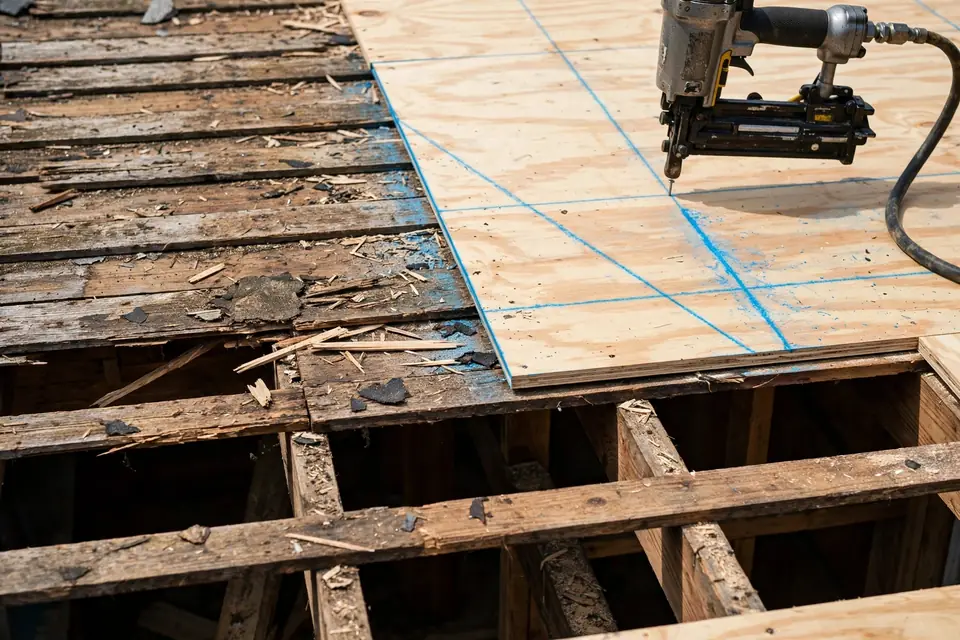
The deck provides the nailing surface for shingles, structural diaphragm strength against wind, and a continuous plane for underlayment. Compromised decking means nails pull out, shingles lift, and warranties void.
How decking fails
Long-term leaks rot plywood from the inside. Poor attic ventilation cooks and delaminates it. Old plank decking gaps and splits with age. From inside the attic you may see water staining, sagging between rafters or daylight at gaps.
What replacement involves
During tear-off, every sheet is probed. Soft, delaminated or rotted sections are cut out and replaced with code-thickness plywood or OSB, re-nailed to current patterns, and photographed. Most contracts include a small allowance (2–4 sheets) with a per-sheet price beyond that — typically $75–$150 per sheet installed.
Protect yourself in the contract
Demand three things in writing: the included decking allowance, the per-sheet overage price, and photo documentation of every replaced section. A contractor who resists any of these is telling you something.
What This Means for Your Towson Roof
Towson's humid subtropical climate swings from hot, humid summers to freeze-thaw winters, and nor'easters rolling up the I-95 corridor batter shingles with wind-driven rain. Summer thunderstorms along the I-695 Beltway add hail risk. That is why timing and material choice matter more than most homeowners realize — a decision made this year protects your home for the next 25 to 50 years.
The Roof Replacement Crew Approach
Every project starts with a photo-documented inspection and a line-item proposal — no vague lump sums. Our experienced roofing specialists handle tear-off, decking repair, underlayment, flashing, ventilation and the finished roofing system, and we clean up with magnetic nail sweeps so your yard is safe the same day.
Local Context: Towson, MD
Colonials, brick ranchers and Cape Cods from the 1940s through the 1970s fill neighborhoods like Rodgers Forge, Stoneleigh and Wiltondale — most on their second or third roof, and many due for full replacement.
Questions About Your Roof?
Call Now — talk to your local roofing team at (888) 974-0663.
Mon-Fri: 8:00 AM - 6:00 PM, Sat: 9:00 AM - 4:00 PM, Sun: Closed • Our call representatives are available 24/7 for emergencies.
Reading Your Deck's Condition Before the Tear-Off
You cannot see decking without removing shingles, but you can read its probable condition from the attic. With a flashlight, look for dark staining around nails (moisture wicking through), sagging between rafters, daylight visible through gaps, and any soft or spongy feel when you press the wood. A musty smell and mold staining underneath point to chronic moisture — typically a bathroom exhaust discharging into the attic instead of outdoors. These signs do not diagnose individual sheets, but they tell you whether to budget a small decking allowance or a large one.
At tear-off, the crew probes every sheet and marks failures: delaminated plywood, swollen OSB that has lost fastener grip, rotted sections at eaves and valleys, plank decking with gaps too wide for modern nailing patterns. Replacement is priced per sheet at a fixed rate agreed in advance — never hourly, never "we'll see." On pre-war Towson homes with plank decking, partial re-sheeting with plywood is sometimes specified to give replacement shingles the solid, continuous nailing base their warranties require. Photograph everything: the marked failures, the new sheets going down, the re-nailing. That file is your proof that the foundation of the new roof is actually new.
OSB vs. Plywood: Does It Matter for Replacement Sheets?
When decking sheets get replaced, the new ones are usually OSB or CDX plywood — and homeowners ask which is better. Honestly installed, both perform: plywood tolerates wetting cycles slightly better and holds fasteners tenaciously, while OSB offers consistency and value. What matters far more than the panel type is the installation: proper spacing at panel edges for expansion, correct fastener patterns, and H-clips or tongue-and-groove edges where spans require them. A well-installed OSB redeck outlasts a sloppy plywood one every time. Ask your contractor what they stock and why — the fluent answer discusses fastening and moisture handling, not brand loyalty.
Frequently Asked Questions
An attic check reveals staining, sagging and soft spots. The definitive answer comes during tear-off when every sheet is probed.
They can be nailed to it — and then they fail. Nails need solid wood to hold against wind; this is non-negotiable.
Rarely on a whole roof — usually it is sections. Full redecking happens with widespread rot from long-term leaks or undersized original sheathing.